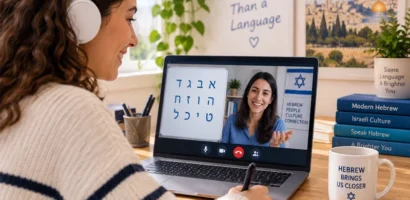
A clear path from your first Hebrew letter to real conversations with Israelis.
Picture yourself at a food stall in Tel Aviv, ordering hummus and joking with the vendor in Hebrew. That’s the goal. You can learn Modern Hebrew faster by following a clear path instead of a hundred scattered tips. This guide maps that path with Rosen School of Hebrew, where you learn online with native Israeli teachers. Your goal decides where you start, so we point you to one of three programs. Modern Hebrew (Ulpan) builds the full set of skills. Let’s Talk Hebrew (Spoken Hebrew) gets you speaking fast. Israel Studies opens up the country itself, with or without the language. Here’s a phrase for day one: מה נשמע (ma nishma). Literally it means what is heard, and it’s how Israelis say what’s up. This is the living language people speak every day. You hear it in the street, the music, and the slang.
The short version:
- Modern Hebrew is a living, everyday language. Learn it the way Israelis use it: out loud and in real situations.
- Your goal picks your track. Modern Hebrew (Ulpan) starts with the alef-bet. Let’s Talk Hebrew (Spoken Hebrew) starts with speaking, and the alphabet comes later.
- Interactive practice with native Israeli teachers beats passive study.
- Everyday conversation comes long before full fluency, so start talking early.
Your roadmap at a glance:
| If your goal is | Your program | Where you start |
|---|---|---|
| Reading, writing, and speaking Hebrew fully | Modern Hebrew (Ulpan) | The alef-bet, then everyday words |
| Speaking and getting by, fast | Let’s Talk Hebrew (Spoken Hebrew) | Useful words and phrases, out loud |
| Getting to know Israel itself | Israel Studies | The country, its culture, and its history |
Your step-by-step roadmap to learn Modern Hebrew
Your goal picks your path, so we keep the paths separate below. Two paths teach the language itself. Modern Hebrew (Ulpan) is the full-skill path, covering reading and writing, speaking and understanding. Let’s Talk Hebrew (Spoken Hebrew) is the speaking-first path for getting by fast. The third path is Israel Studies. It covers the country, its culture, and its history. You can take it with or without the language. Every path runs online with a native Israeli teacher. First, everyone does the same thing, which is to get clear on your goal. That picks your path. From there, each path below stands on its own, with its own steps starting at Step 1.
First, start with your why
Your reason shapes every choice, so name it first. Want to speak with family and friends, or get by on a trip? That points to Let’s Talk Hebrew, our Spoken Hebrew track. Want a full foundation, university credit, or Aliyah prep? That’s Modern Hebrew, our Ulpan. Curious about the country, its culture, and its history? Israel Studies leans into that. Write your goal down and put it where you’ll see it, because it pulls you forward when a lesson gets hard. There’s a quieter payoff too. Learning a language through immersion appears to sharpen your attention and mental alertness. Hebrew adds its own workout: a new alphabet, right-to-left reading, and a root-based system.
The Modern Hebrew (Ulpan) path: the full-skill roadmap
Pick this path for the full set of skills: reading and writing, speaking and understanding. It starts with the alphabet and builds structured skills on top. You climb level by level, up to reading an Israeli newspaper. You set your goal in the why step above, so start this path at Step 1 below.

Step 1: Learn the alef-bet
Learn the alphabet first, because the rest of this path sits on it. The אלפבית (alef-bet) has 22 letters and reads from right to left. It looks intimidating for a few days, then it clicks. Every letter is a consonant, and a few double as vowels. Hebrew also has a vowel system of dots and lines around the letters, but everyday writing leaves it out and you read from context. That sounds hard, but students pick it up fast. We teach the letters in Hebrew from day one, the way a child in Israel meets them.
Step 2: Build a base of everyday words
Stock up on words you’ll use the moment you land, before you worry about grammar. Focus on greetings, food, and getting around. A few to start:
- שלום (shalom): hello, goodbye, and peace, all in one word.
- תודה (toda): thank you.
- בבקשה (bevakasha): please, or here you go when you hand something over.
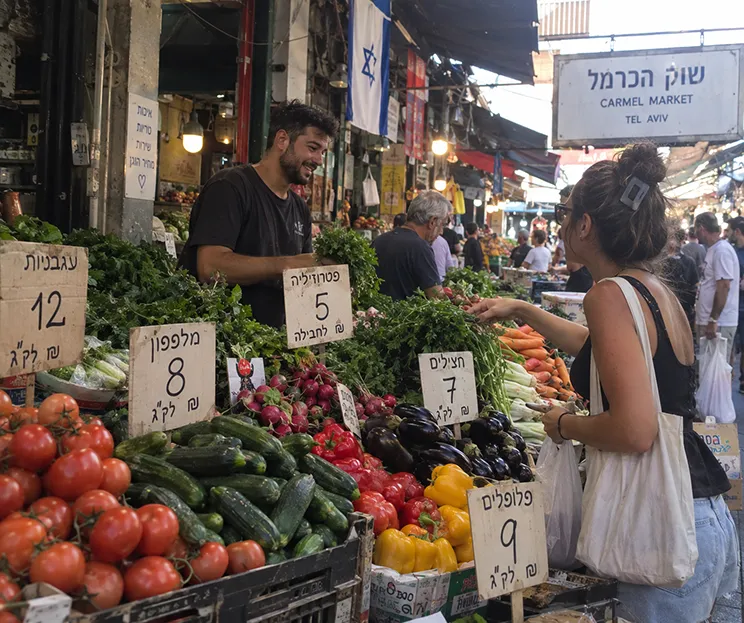
- כמה זה עולה (kama ze ole): how much does this cost, your best friend at the market.
Learn them in chunks, like a whole greeting or a food order, not as lonely words on a list. Chunks stick.
Step 3: Ask and answer everyday questions
Once you have a handful of words, learn to ask and answer the small questions that get you through a day. Practice how much does this cost: כמה זה עולה (kama ze ole). You’ll use it at every market. Learn where is it: איפה (eifo). It finds a bus, a bathroom, or a cafe. Learn to ask the time too, and to catch the numbers in the answer. These short exchanges do more for daily life than any grammar rule does this early.
Step 4: See how Hebrew words are built
Now that you can handle basic exchanges, meet the engine under the words. Most Hebrew words grow from a root of three consonants, a שורש (shoresh), which means root. One root branches into a family of related words, so every root you learn pays off many times. Early on it’s just an introduction, and the real payoff grows as your foundation does. Start with the present tense, where Hebrew stays close to English word order. Grammar is the stage where a live teacher saves you the most time. A quick explanation of how a root works clears up in minutes what would take weeks to guess alone.

Step 5: Train your ear and start speaking
Talking is where Hebrew sticks, so speak out loud early and often. Fill your ears with Israeli sound every day: Israeli songs, TV dramas, and podcasts. Copy what you hear, then say it back. Practice with Rosie, our online bot, who listens and keeps correcting you until a sentence comes out right. Then get in front of real people, because a live conversation teaches more in ten minutes than an hour of passive study.
You’ll hear two words on repeat. One is סבבה (sababa), a casual way to say cool or all good. The other is יאללה (yalla), meaning let’s go or come on. Our Israeli Accent course helps you sound like a local, and you can add it to any track.
Step 6: Read real Israeli content and keep a steady routine
Once you can hold a basic conversation, feed your Hebrew with the real thing. Start small with a menu, a street sign, or a line from a song you like. Work up to social posts, then short articles, then the news. This climb is how our Modern Hebrew course is built, level by level from the alphabet to reading an Israeli newspaper. Consistency wins. Ten focused minutes most days beats one long session a month.
The Let’s Talk Hebrew (Spoken Hebrew) path: speak and get by fast
Pick this path if you mainly want to speak and get by fast. It fits talking with family, getting around on a trip, or making Israeli friends. It’s speaking-first: less grammar, more talking. The alphabet comes later. When you need it, an explanation comes in your own language, English or Spanish. You set your goal in the why step above, so start this path at Step 1 below.
Step 1: Start with useful words and phrases
Skip the alphabet for now and start with words you can say out loud today. Learn greetings, food, and getting around. These are the everyday chunks a traveler needs first. שלום (shalom) covers hello and goodbye. תודה (toda) is thank you, and בבקשה (bevakasha) is please or here you go. Say them in whole phrases, not single words, so they come out naturally.
Step 2: Ask and answer everyday questions
Two questions carry a whole trip. כמה זה עולה (kama ze ole) means how much does this cost. איפה (eifo) means where is it. Add asking the time, and practice catching the numbers in the answer. You don’t need grammar for these, just the phrases and the confidence to use them.
Step 3: Fill your ears with Israeli sound
Surround yourself with spoken Hebrew every day. Play Israeli songs, watch Israeli shows and clips, and let the rhythm sink in. Copy a line out loud, then say it back from memory. Practice with Rosie, our online bot. It gives you games and practice at your level, and you keep going until it sounds right. You’ll start catching two words everywhere. סבבה (sababa) is a casual cool or all good. יאללה (yalla) is a let’s go or come on.
Step 4: Speak with real people
The whole point of this path is talking, so get in front of real people early. In class you speak with a native Israeli teacher from the first lesson, and every lesson is recorded so you can replay what you said. Between classes, the student forum and weekly practice sessions keep you talking. Take every chance to talk with Israelis, even when your Hebrew is small. A shop, a cafe, or an online chat all count. A short live conversation teaches more than an hour of review. This is exactly what our Let’s Talk Hebrew classes are built for, and our Israeli Accent course helps you sound like a local.
The Israel Studies path: get to know Israel
Some learners care most about the country itself, not the grammar. If that’s you, Israel Studies is your path. You explore the country week by week: its culture, its history, and the places worth seeing. You can go deep on the language or leave it aside. It’s the story behind the language, for anyone drawn to the place more than the verb tables.
Learn with people who live the language
Who teaches you matters most. Hebrew learned from a native Israeli teacher comes with the real accent, the real slang, and the culture around every lesson. That’s how we teach at Rosen. Classes run in Hebrew from the start, led by native Israeli teachers who care about your progress, with lessons built for online learning for more than 20 years. By the school’s own numbers, that method has taught 100,000 students, with a team of around 100 teachers. Group study sessions come with the Ulpan at no extra cost, every lesson is recorded, and Rosie is there to practice between classes. Accredited courses carry 2 Hebrew University of Jerusalem credits per course on Ulpan levels 1 to 6, earned through special assignments and a final exam. Want more culture along the way? Our blog is full of Hebrew words, Israeli food, and daily life.
Ready to start?
You don’t need a gift for languages. You need a clear path and steady reps. Pick your why, choose your path, and start speaking as soon as you can. When you’re ready for a live classroom, start your journey with a native Israeli teacher. Learn the language, and the real Israel opens up.
FAQ
-
What's the best way to learn Modern Hebrew?
Study it out loud and in context, with native Israeli teachers and real cultural material, instead of passive memorization. Speak early, listen to Israeli media, and review a little each day. That beats cramming grammar in isolation.
-
Do I need to learn the Hebrew alphabet first?
It depends on your track. In our Modern Hebrew Ulpan, yes. Reading and writing build on the letters, and most people get comfortable in a few days. In our Spoken Hebrew course it isn’t required. Some students find a new alphabet hard, so we take that barrier away and teach a different way, focused on speaking.
-
Can you learn Modern Hebrew online?
Yes, and it’s what we do best. Rosen specializes in online learning, and over more than 20 years we’ve built a method that makes online an advantage, not a compromise. You learn in live classes with a native Israeli teacher and classmates from around the world, so you’re speaking from the first lesson.
-
How long does it take to become conversational in Hebrew?
Most motivated learners reach everyday conversation in a matter of months, well before full fluency. Hebrew is a harder language for English speakers, and the US Foreign Service Institute puts it in its Category III for full professional command, at about 44 weeks. Daily practice and real speaking time get you to everyday chat much sooner.
-
Is Modern Hebrew the same as Biblical Hebrew?
They’re the same language at heart. Modern Hebrew grew out of the classical language and keeps its alphabet and roots, with new words added for modern life. Israeli schoolchildren read older Hebrew texts and follow them through the everyday Hebrew they speak. Some old words have dropped out of use and the grammar has shifted, which is normal for a language this old.
Sources
- Encyclopaedia Britannica (Modern Hebrew is the official language of Israel, revived as a spoken language in modern times): https://www.britannica.com/topic/Hebrew-language
- Wikipedia (Modern Hebrew has over 10 million speakers. The alef-bet has 22 letters, reads right to left, and uses three-letter roots): https://en.wikipedia.org/wiki/Modern_Hebrew
- US Department of State, Foreign Service Institute (Hebrew is an FSI Category III hard language, needing about 44 weeks, roughly 1,012 class hours, to reach professional proficiency): https://www.state.gov/national-foreign-affairs-training-center/foreign-language-training
- Rosen School of Hebrew (Rosen teaches eight Modern Hebrew levels from the alef-bet to Israeli news, and its accredited courses carry two Hebrew University credits.): https://rosenhebrewschool.com/courses/modern-hebrew/
- Rosen School of Hebrew (The Rosen School of Hebrew school reports 100,000 students and 300 teachers since 2000): https://rosenhebrewschool.com/about/