A clear, no-spin look at the full Hebrew programs worth your time this year
You’ve decided to learn Hebrew, opened a new tab, and hit a wall of choices. Apps, tutors, and full ulpan programs all claim to be the best. So which one actually earns your time and money? This guide compares the best online Hebrew courses of 2026 as whole programs, the kind with a real curriculum and live classes, not a single lesson here and there. We look at how each modern Hebrew course teaches, how classes run, and what it costs. That way, choosing a Hebrew language school online feels clear, not overwhelming.
One quick word first. The language of daily life in Israel is Modern Hebrew, called עברית (ivrit, meaning Hebrew). That is what these programs teach. If your goal is reading scripture in the original, that is a separate path, and it is not our focus here.
How we compared these online Hebrew courses
There are lots of ways to learn Hebrew online, so we looked at whole programs only, no apps and no one-off tutor marketplaces. Each pick below runs a structured, multi-level course with live teaching and a clear method. Each one takes you from beginner to real conversation. We compared how each program teaches, how classes run, and what it costs. Other solid programs exist too, so treat this as a shortlist of the most cited full programs, not every option on the internet.
An אולפן (ulpan, meaning an intensive Hebrew course) is the classic format most of these build on. The word shows up everywhere once you start looking.
What actually matters when you choose
- Live or self-paced. Live classes give you speaking practice and feedback. Self-paced study is cheaper and flexible, but you talk less.
- Who teaches. Native Israeli or Israel-based teachers bring real accent, slang, and culture into the room.
- Modern or academic feel. Some programs feel like a fun conversation. Others feel like a college semester.
- How far it goes. Check the number of levels, so the course can carry you past the basics.
- Credit. A few programs carry university credit. Most ulpan-style courses do not.
- Price clarity. Some publish prices. Others quote you after a free assessment.
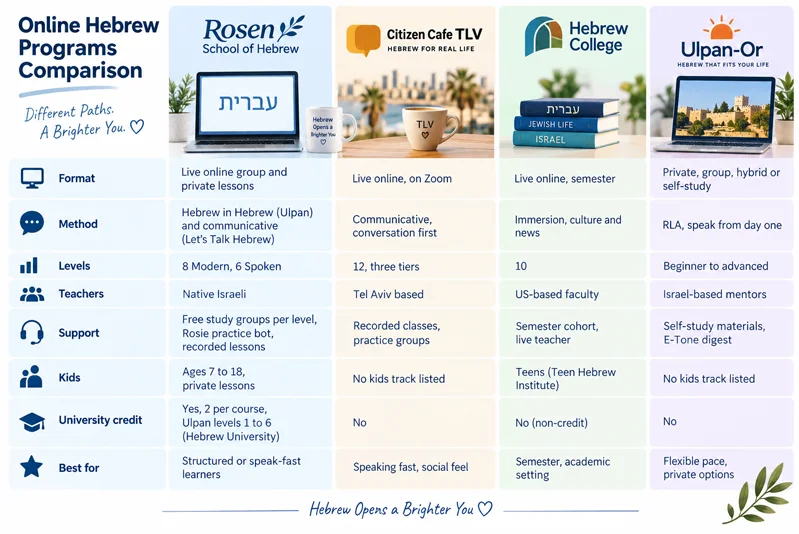
The best online Hebrew courses in 2026, compared
| Rosen School of Hebrew | Citizen Cafe TLV | Hebrew College | Ulpan-Or | |
| Format | Live online group and private lessons | Live online, on Zoom | Live online, semester | Private, group, hybrid or self-study |
| Method | Hebrew in Hebrew (Ulpan) and communicative (Let’s Talk Hebrew) | Communicative, conversation first | Immersion, culture and news | RLA, speak from day one |
| Levels | 8 Modern, 6 Spoken | 12, three tiers | 10 | Beginner to advanced |
| Teachers | Native Israeli | Tel Aviv based | US-based faculty | Israel-based mentors |
| Support | Free study groups per level, Rosie practice bot, recorded lessons | Recorded classes, practice groups | Semester cohort, live teacher | Self-study materials, E-Tone digest |
| Kids | Ages 7 to 18, private lessons | No kids track listed | Teens (Teen Hebrew Institute) | No kids track listed |
| University credit | Yes, 2 per course, Ulpan levels 1 to 6 (Hebrew University) | No | No (non-credit) | No |
| Best for | Structured or speak-fast learners | Speaking fast, social feel | Semester, academic setting | Flexible pace, private options |
Rosen School of Hebrew
Rosen is a live, teacher-led modern Hebrew course built on the Hebrew in Hebrew immersion method, with native Israeli teachers. You can study in a small group or in private lessons. There are two ways to learn. The Modern Hebrew track is an Ulpan. It runs 8 levels, from the alphabet to reading an Israeli newspaper and discussing current events. The Spoken Hebrew track, called Let’s Talk Hebrew, adds 6 conversation levels. It is built for English and Spanish speakers, with explanations in your own language when you need them. You can add an Israeli Accent course to either track, so you sound less like a textbook and more like a local. Culture is baked in, from slang to songs to everyday Israeli life. Rosen has taught online for more than 20 years, with materials built for online learning. Its numbers include 100,000 students and around 100 teachers, with about 600 classes running a year. Accredited courses carry 2 Hebrew University of Jerusalem credits per course, for Ulpan levels 1 to 6, which most competitors cannot match. The program wraps in real support too. Study groups at each level come at no extra cost, a practice bot called Rosie gives you games and practice at your level, and every lesson is recorded for you to replay. Rosen even teaches Hebrew for Kids, ages 7 to 18, in private lessons with specially trained teachers. Rosen fits both students who want to build thorough foundations of the Hebrew language and students who wish to focus on conversation and getting along in Israel. It is a paid program, not a free ulpan, and not a self-paced app.
Citizen Cafe TLV
Citizen Cafe TLV runs live online classes on Zoom, taught by teachers based in Tel Aviv. The method is communicative and conversation first, so you practice speaking from the start. Courses span 12 levels across three tiers. Those tiers are Foundation, Flow, and Freedom. Each tier runs on a 10-week semester. The feel is modern and social, with everyday Hebrew and plenty of slang. Learn a word like סבבה (sababa, meaning cool or all good) and you start to sound at home. Best for learners who want to speak fast with a relaxed, current vibe. One thing to know upfront. Pricing is not listed on the site. You book a free intro session, get placed at your level, and receive a quote after that.
Hebrew College Ulpan
Hebrew College is a US-based college that runs an online Ulpan as part of its community education. It teaches conversational Hebrew through the lens of Israeli culture, built on immersion and real discussion of current Israeli news. The Ulpan is offered online across 10 levels, from beginner to advanced, on a semester schedule. Best for learners who like a semester rhythm and an academic setting. The honest caveat. The Ulpan is non-credit, and Hebrew College keeps its degree-level and textual Hebrew in separate graduate tracks. So this path is about speaking and reading modern Hebrew, not earning a transcript.
Ulpan-Or
Ulpan-Or teaches modern, everyday Hebrew through its RLA method (Right-Brain Learning Approach), built to get you speaking from day one instead of drilling grammar. You can learn one-on-one, in a live online group, or in a hybrid setup. Self-study materials are available too, including the E-Tone Hebrew news digest. Teaching is done by Israel-based mentors, online over Zoom or in person in Israel. Best for learners who want a flexible pace and private, one-on-one options. Because the format is so flexible, pricing depends on the path you pick, so check the course pages for the option that fits.

Which online Hebrew course is right for you?
Choosing a Hebrew language school online is really about matching a program to your goal. If you want live online Hebrew classes, a clear path, and university credit, a program like Rosen fits. You can start with Rosen’s Modern Hebrew course or the conversation-focused Spoken Hebrew course. Want a relaxed, speak-first vibe? Rosen’s Spoken Hebrew track is built for exactly that, and Citizen Cafe TLV or Ulpan-Or are options too. If you like a semester feel, Hebrew College works well. The best modern Hebrew course is the one you’ll show up for each week. Want to see how live classes feel? Request info from Rosen to get started.
Frequently asked questions
-
What is the best online Hebrew course in 2026?
There’s no single best online Hebrew course, because the right pick depends on your goal. For live Modern Hebrew with native Israeli teachers and optional university credit, Rosen is a strong choice. Rosen’s Spoken Hebrew track is built for a speak-first, social feel, and Citizen Cafe TLV and Ulpan-Or are strong there too. Rosen also opens new sessions through the year, so you can usually start close to when you sign up.
-
Are live online Hebrew classes better than self-paced study?
For most learners who want to actually speak, live online Hebrew classes beat self-paced study. You get real conversation, feedback, and a teacher who corrects you in the moment. Live classes also build commitment. A teacher, classmates, and a set weekly slot make it hard to keep postponing. Self-paced study is cheaper and more flexible, and it works well as a supplement. You just practice speaking far less. Many learners pair the two, using self-study for vocabulary and a live course as the main engine.
-
How much do online Hebrew courses cost?
Prices vary widely by format and provider. Some schools publish per-level or semester pricing, while others give you a quote after a free level assessment. Self-study materials cost the least, live group classes sit in the middle, and private one-on-one lessons cost the most.
-
Can you earn university credit for learning Hebrew online?
Yes, but only with certain programs. Rosen’s accredited Modern Hebrew courses carry 2 Hebrew University of Jerusalem credits per course, for Ulpan levels 1 to 6, earned through special assignments and a final exam. Most ulpan-style programs, including Hebrew College’s Ulpan, are non-credit and focus on speaking and reading rather than a transcript.
Sources
- Rosen School of Hebrew (8 levels, 2 Hebrew University credits, curriculum from alphabet to current events): https://rosenhebrewschool.com/courses/modern-hebrew/
- Rosen School of Hebrew (Let's Talk Hebrew, 6 levels, accent course): https://rosenhebrewschool.com/courses/spoken-hebrew/
- Rosen School of Hebrew (HUJI-accredited academic track): https://rosenhebrewschool.com/certificates/
- Rosen School of Hebrew (Hebrew University partnership, since 2000, 100,000 students, about 1,000 classes a year): https://rosenhebrewschool.com/about/
- Citizen Cafe TLV (live Zoom classes, communicative method, 12 levels across Foundation, Flow, and Freedom, 10-week semesters, quote after a free intro): https://www.citizencafetlv.com/online-hebrew-learning/
- Hebrew College (online, ten levels, immersion, culture and current Israeli news, non-credit): https://hebrewcollege.edu/programs/ulpan-modern-hebrew/
- Ulpan-Or (RLA described on the method page as the Right-Brain Learning Approach, speak from day one): https://www.ulpanor.com/ulpanor-method/
- Ulpan-Or (weekly Hebrew news digest drawn from Israeli media): https://www.ulpanor.com/e-tone/